


Profitable intraday trading advice 66unblockedgames.com represents an innovative educational approach where a popular gaming website teaches stock market day trading strategies by leveraging gaming metaphors, making complex financial concepts accessible to beginners who understand game mechanics better than traditional finance terminology. Published on 66unblockedgames.com—a platform primarily known for hosting browser-based games accessible from restricted networks—this trading education content uses familiar gaming concepts like health bars, power-ups, level progression, and risk-reward calculations to explain stock selection criteria, technical indicators, entry and exit timing, risk management principles, and psychological discipline required for successful intraday trading. With practical advice covering momentum trading, breakout strategies, scalping techniques, and the popular 9:20 opening strategy, this unconventional resource bridges the gap between entertainment and financial education.
Understanding profitable intraday trading advice 66unblockedgames.com is valuable for aspiring traders, particularly younger investors or career changers, who find traditional finance education intimidating but respond well to gamified learning approaches that frame trading as a skill-based challenge requiring strategy, practice, and continuous improvement. The platform’s unique positioning demonstrates that financial literacy can be taught through non-traditional channels, making crucial concepts like position sizing, stop-loss placement, and technical analysis accessible to audiences who might never pick up conventional trading books or enroll in expensive courses.
Understanding Intraday Trading Basics
Before diving into specific advice from 66unblockedgames.com, it’s essential to understand what intraday trading actually involves. Also called day trading, this practice involves buying and selling financial instruments within the same trading day, with all positions closed before markets close to avoid overnight risk.
| Trading Style | Time Horizon | Typical Trades/Day | Capital Requirements | Skill Level |
| Intraday/Day Trading | Minutes to hours | 5-20+ | $25,000+ (US pattern day trader rule) | Advanced |
| Swing Trading | Days to weeks | 2-5 per week | $5,000-10,000 | Intermediate |
| Position Trading | Weeks to months | 1-2 per month | $10,000+ | Intermediate |
| Long-term Investing | Years | Occasional | Any amount | Beginner-friendly |
Intraday trading is arguably the most challenging trading style, requiring constant market monitoring, quick decision-making, emotional discipline, technical analysis skills, and sufficient capital to meet regulatory requirements while managing risk appropriately.
The Gaming-Trading Connection
66unblockedgames.com’s innovative approach draws deliberate parallels between gaming and trading that make financial concepts immediately relatable to their core audience.
Health Bar = Account Balance
Just as game characters have health points that must be protected, traders have account balances that determine survival. Taking too much damage (losses) results in “game over” (blown account). The advice emphasizes defensive play—preserving your “health” takes priority over aggressive offense.
Power-Ups = High-Probability Setups
In games, power-ups provide temporary advantages. In trading, high-probability setups (specific chart patterns or technical indicator alignments) offer similar advantages. The key is recognizing when these opportunities appear and acting decisively.
Level Progression = Skill Development
Games feature level systems where players gradually unlock new abilities. Trading follows similar progression: beginners start with simple strategies and small position sizes, gradually advancing to complex techniques and larger trades as competence grows.
Boss Fights = Volatile Market Events
Major market events (Fed announcements, earnings reports, geopolitical crises) resemble boss battles—high risk but potentially high reward situations requiring preparation, strategy, and sometimes the wisdom to skip the fight entirely.
This gaming framework isn’t mere gimmickry; it leverages existing mental models to accelerate learning, making abstract financial concepts concrete and memorable.
Core Intraday Trading Principles
The 66unblockedgames.com content emphasizes several foundational principles that separate successful intraday traders from those who lose money consistently.
Stock Selection Criteria
Not all stocks are suitable for intraday trading. The advice recommends focusing on liquid stocks with daily trading volume exceeding 1 million shares, price volatility providing meaningful intraday movement, sufficient price (typically $5+) to allow percentage gains, news catalysts driving price action, and clear technical patterns on charts.
Trading illiquid stocks creates problems: wide bid-ask spreads that erode profits, difficulty entering positions at desired prices, inability to exit positions quickly when needed, and susceptibility to manipulation by larger players.
The 2% Risk Management Rule
Perhaps the most critical advice: never risk more than 2% of your total trading capital on any single trade. This rule ensures that even a string of losses won’t devastate your account.
| Account Size | 2% Risk per Trade | Number of Losing Trades to Lose 50% |
| $10,000 | $200 | 35+ consecutive losses |
| $25,000 | $500 | 35+ consecutive losses |
| $50,000 | $1,000 | 35+ consecutive losses |
The math demonstrates why this rule works: losing 2% requires gaining only 2.04% to break even, but losing 50% requires gaining 100% to recover. The 2% rule keeps you in the game through inevitable losing streaks.
Stop-Loss Discipline
Stop-loss orders automatically sell positions when prices reach predetermined levels, limiting losses on trades that move against you. The content emphasizes setting stop-losses before entering trades (never after), placing them beyond recent support/resistance levels, never moving stop-losses further away from entry, and accepting losses as business expenses, not personal failures.
The gaming analogy: stop-losses are like saving your game before a difficult section. They ensure that when you fail (and you will), you restart from a manageable position rather than the beginning.
Optimal Trading Times
The content highlights specific times when intraday opportunities are most abundant, driven by market dynamics and participant behavior.
| Trading Period | Time (EST) | Characteristics | Strategy Suitability |
| Market Open | 9:30-10:30 AM | Highest volume, volatility | Momentum, breakout |
| Mid-Morning | 10:30 AM-12:00 PM | Declining volume, range-bound | Range trading |
| Lunch Period | 12:00-2:00 PM | Lowest volume, choppy | Avoid trading |
| Afternoon | 2:00-3:00 PM | Moderate activity | Continuation patterns |
| Power Hour | 3:00-4:00 PM | Increasing volume, trend continuation | Momentum, reversals |
The Opening 20-30 Minutes
The first half-hour after market open (9:30 AM EST) sees maximum volatility as overnight news gets priced in, large institutional orders execute, and retail traders react to pre-market movements. This creates opportunities but also significant risk. The advice recommends that beginners observe rather than trade during this period, learning to identify patterns before risking capital.
The Final Hour
The last hour before close (3:00-4:00 PM EST) sees increased activity as day traders close positions, institutional investors make final adjustments, and algorithms execute closing orders. This “power hour” often sees trend acceleration or reversal as the day’s dominant narrative resolves.
Popular Intraday Trading Strategies
66unblockedgames.com covers several battle-tested strategies suitable for different market conditions and trader personalities.
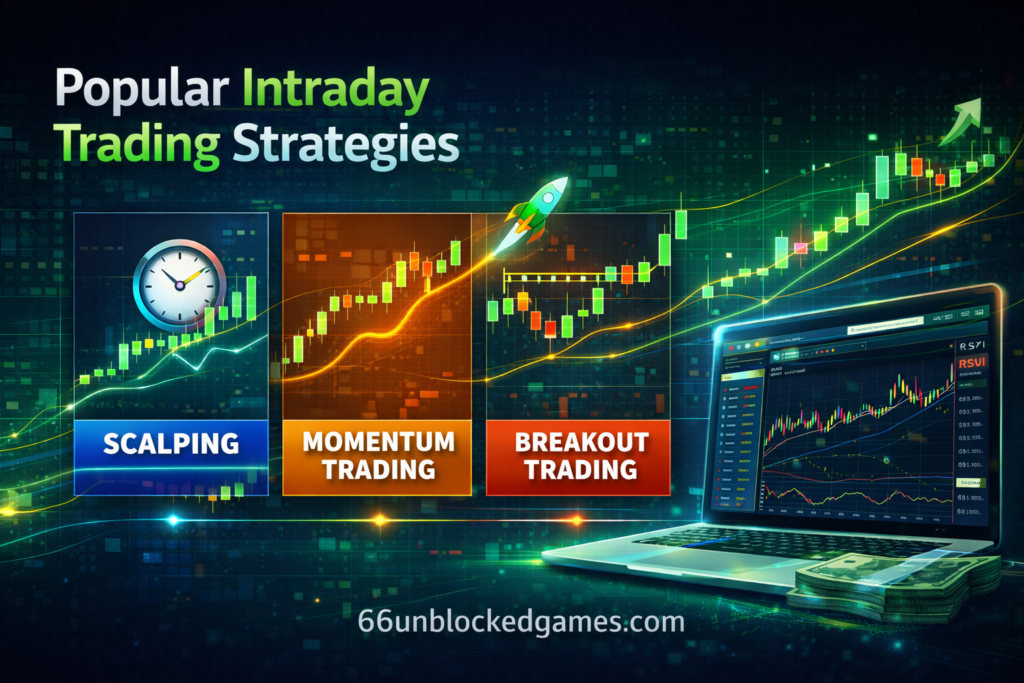
Momentum Trading
This strategy involves identifying stocks showing strong directional movement and “riding the wave” until momentum fades. Traders look for stocks hitting new highs/lows on increased volume, breaking through significant resistance/support levels, responding to positive/negative news catalysts, and showing consistent buying/selling pressure.
The gaming analogy: catching a “combo multiplier” where successive hits increase damage—momentum traders stack gains by staying with strong trends.
Example: A pharmaceutical stock announces FDA drug approval at 9:45 AM. The stock jumps 8% on 10x normal volume. Momentum traders enter on the second or third 5-minute candle showing continued strength, ride the move to 12-15% gains, and exit when volume starts declining or the stock makes a lower high.
Breakout Trading
Breakouts occur when prices move beyond defined support or resistance levels, often triggering acceleration as stop-losses trigger and new participants enter. Traders identify clear consolidation ranges (sideways movement), wait for decisive breaks with increased volume, enter after confirmation (price sustains beyond breakout level), and place stops just below breakout point.
Example: A tech stock trades between $47-50 for three days, forming a rectangular consolidation pattern. When price breaks above $50 on 3x volume at 10:15 AM, breakout traders enter at $50.20, target $53 (measuring the $3 range and projecting it from breakout), and place stops at $49.75.
Scalping
Scalping involves making numerous small-profit trades throughout the day, accumulating gains through volume rather than large percentage moves. Scalpers target liquid, fast-moving stocks, hold positions for seconds to minutes, accept small profits (0.1-0.5%), and execute 20-100+ trades daily.
This high-frequency approach requires intense focus, fast execution platforms, low commission structures, and psychological comfort with rapid decision-making. It’s likened to “farming” low-level enemies in games—individually small rewards that accumulate significantly over time.
Mean Reversion
This strategy assumes that prices tend to return to average levels after extreme movements. Traders identify overbought stocks (RSI >70, extended above moving averages), watch for signs of exhaustion (decreasing momentum, volume decline), enter short positions or puts when reversal signals appear, and target returns to moving averages or previous support levels.
Mean reversion works because emotional extremes (fear and greed) eventually give way to rational reassessment.
Strategy Comparison
| Strategy | Trades/Day | Hold Time | Win Rate | Avg Win/Loss | Difficulty |
| Momentum | 2-5 | 30 min-2 hours | 40-50% | 2:1 or better | Moderate |
| Breakout | 1-3 | 1-3 hours | 40-45% | 2.5:1 | Moderate |
| Scalping | 20-100+ | Seconds-minutes | 55-65% | 1:1 to 1.5:1 | Very High |
| Mean Reversion | 2-4 | 30 min-1 hour | 50-60% | 1.5:1 | Moderate-High |
The 9:20 Strategy
One specific strategy detailed on 66unblockedgames.com is the “9:20 Strategy,” which uses the first 20 minutes of trading to establish day trading plans.
How It Works:
- Pre-Market Analysis (9:00-9:30 AM): Identify stocks with significant pre-market movement (+/- 3% or more), news catalysts driving the movement, and high pre-market volume.
- Observe Opening 20 Minutes (9:30-9:50 AM): Watch how identified stocks react at the open. Do they extend pre-market moves or reverse? Where do they find support/resistance?
- Identify Pattern (9:50 AM): Determine the developing pattern—continuation (pre-market trend continues), reversal (opening move fades), or range (stuck between levels).
- Execute Strategy (9:50 AM-10:30 AM): Enter positions based on identified patterns with clear stops and targets.
Example: Stock gaps up 5% pre-market on earnings beat. Opening 20 minutes shows initial selling to $51 (from $53 gap), then strong buying back to $52.50. This “higher low” pattern suggests continuation. Entry at $52.60 with stop at $51.80 and target $55+ captures the likely upside continuation.
Technical Analysis Tools
The content introduces several technical indicators frequently used by intraday traders, explaining them through accessible analogies.
Moving Averages
Moving averages smooth price data to identify trends. Common periods include 9, 20, 50, and 200-period MAs. When price is above MA, trend is bullish; below MA, trend is bearish. MA crossovers signal potential trend changes.
Gaming analogy: Moving averages are like “safe zones” in games—areas where your character (the stock price) feels comfortable. Venturing far from them increases risk; returning to them provides stability.
Relative Strength Index (RSI)
RSI measures momentum on a 0-100 scale. Readings above 70 suggest overbought conditions (potential reversal down), while readings below 30 suggest oversold conditions (potential reversal up). Traders watch for divergences where price makes new highs/lows but RSI doesn’t, signaling weakening momentum.
Candlestick Patterns
Candlestick charts display open, high, low, and close prices for each time period. Specific patterns signal potential reversals or continuations. Key patterns include doji (indecision), hammer (potential bullish reversal), shooting star (potential bearish reversal), and engulfing patterns (strong reversal signals).
Volume Analysis
Volume confirms price movements. Strong moves on high volume are more reliable than those on low volume. Decreasing volume during trends suggests exhaustion. Volume spikes often precede reversals or breakouts.
Technical Indicators Overview
| Indicator | Type | Primary Use | Signal Interpretation |
| Moving Averages | Trend | Identify direction | Above = bullish, Below = bearish |
| RSI | Momentum | Overbought/oversold | >70 overbought, <30 oversold |
| MACD | Momentum | Trend strength | Crossovers signal changes |
| Bollinger Bands | Volatility | Price extremes | Touches = potential reversal |
| Volume | Confirmation | Validate moves | High volume = strong conviction |
Risk Management and Position Sizing
Beyond the 2% rule, the content emphasizes comprehensive risk management that protects capital while allowing profit potential.
Position Sizing Formula
The proper position size depends on your account size, risk percentage, and stop-loss distance:
Position Size = (Account Size × Risk %) / (Entry Price – Stop Price)
Example: $25,000 account, 2% risk ($500), buying stock at $50 with stop at $49 ($1 risk per share):
Position Size = $500 / $1 = 500 shares
This ensures that if stopped out, you lose exactly $500 (2% of capital).
Risk-Reward Ratios
Successful trading requires favorable risk-reward ratios. Minimum acceptable is typically 1.5:1, but many traders target 2:1 or 3:1—risking $1 to potentially make $2-3.
| Risk-Reward Ratio | Win Rate Needed to Break Even | Realistic Performance |
| 1:1 | 50% | Difficult—commissions create loss |
| 1.5:1 | 40% | Achievable with discipline |
| 2:1 | 33% | Comfortable margin for error |
| 3:1 | 25% | Lower pressure, higher returns |
Scaling In and Out
Rather than entering/exiting entire positions at once, experienced traders scale in (add to winning positions) and scale out (take partial profits at targets while letting remainder run). This approach reduces pressure to time entries/exits perfectly.
Psychological Aspects of Trading
The 66unblockedgames.com content acknowledges that technical skills alone don’t ensure success—psychological discipline often determines outcomes.
Common Emotional Pitfalls
- Fear of Missing Out (FOMO): Chasing trades after moves have already occurred
- Revenge Trading: Making impulsive trades to recover losses quickly
- Overconfidence: Increasing risk after winning streaks
- Loss Aversion: Holding losing positions hoping for recovery
- Analysis Paralysis: Over-analyzing to avoid making decisions
Developing Trader Discipline
The gaming analogy extends to psychological preparation: treat trading like practicing for competitive gaming—reviewing losses to learn rather than dwelling emotionally, maintaining consistent routines regardless of recent results, setting daily loss limits (stop trading after losing X%), and keeping detailed journals documenting trades and emotions.
Tools and Resources Recommended
Demo/Paper Trading Accounts
Before risking real capital, practice with simulated accounts offering real-time data without financial risk, realistic order execution, and opportunity to test strategies. Most brokers offer free paper trading platforms.
Trading Journals
Document every trade including entry/exit prices and reasons, stop-loss and target levels, screenshots of charts at entry, emotional state during the trade, and what was learned regardless of outcome.
This record reveals patterns in your behavior and decision-making that spreadsheets alone won’t show.
Charting Software
Professional-grade tools include TradingView (web-based, excellent for beginners), MetaTrader 4/5 (advanced, many indicators), and Thinkorswim (TD Ameritrade’s platform, comprehensive).
News Aggregators
Stay informed through Bloomberg Terminal (professional but expensive), Benzinga Pro (real-time news with social sentiment), and Twitter/StockTwits (crowd sentiment, taken with skepticism).
Realistic Expectations and Statistics
The content doesn’t sugarcoat trading’s difficulty, sharing sobering statistics that context-set appropriate expectations.
Industry Statistics
- Only 10-15% of intraday traders maintain consistent profitability
- 80% of day traders quit within 2 years
- Average intraday trader loses money in their first year
- Successful traders typically spend 1-2 years developing skills before consistency
Capital Requirements
U.S. regulations require “pattern day traders” (those making 4+ day trades within 5 business days) to maintain $25,000 minimum account balance. This regulation protects retail traders from excessive leverage but creates barrier to entry.
Time Investment
Successful intraday trading requires pre-market preparation (1-2 hours), active trading hours (2-4 hours), post-market analysis and journaling (1 hour), and continuous education and strategy refinement.
It’s effectively a full-time job, not passive income.
Conclusion
Profitable intraday trading advice 66unblockedgames.com demonstrates that financial education can successfully leverage non-traditional formats and unexpected platforms to reach audiences who might otherwise never engage with investing concepts. By using gaming metaphors, accessible language, and practical strategies, this content makes complex topics like technical analysis, risk management, position sizing, and trading psychology approachable for beginners while still providing substantive, actionable guidance. The core principles emphasized—stock selection discipline, the 2% risk rule, stop-loss usage, optimal timing, and psychological discipline—represent genuinely sound advice that aligns with what professional traders advocate.
However, it’s crucial to recognize that profitable intraday trading advice 66unblockedgames.com provides educational foundation, not guaranteed profits. The sobering statistics—only 10-15% of day traders achieve consistent profitability, 80% quit within two years—reflect trading’s genuine difficulty regardless of how well concepts are explained. The gaming analogies that make learning accessible shouldn’t obscure the reality that real money is at stake, losses feel different than game deaths, emotional discipline requires conscious development, and success demands months or years of practice and refinement. For those willing to invest the time, capital, and emotional energy required, the strategies and principles presented offer legitimate starting points, but the journey from understanding concepts to executing them profitably under pressure represents the true challenge that separates educational knowledge from trading success.

