


Who Is Bad Bunny
Bad Bunny is a Puerto Rican rapper, singer, songwriter, and record producer born Benito Antonio Martínez Ocasio on March 10, 1994 in Bayamón, Puerto Rico, who grew up in the working-class neighbourhood of Almirante Sur in Vega Baja. He is the most commercially dominant Latin music artist of his generation — the most-streamed artist globally on Spotify four times since 2020, the first artist in Grammy history to win Album of the Year for a Spanish-language album, and the first headliner to perform a Super Bowl halftime show primarily in Spanish. He did all of this while being a former supermarket bagger who dropped out of the University of Puerto Rico at Arecibo and uploaded his first songs to SoundCloud from Vega Baja — a town approximately thirty miles west of San Juan that had not previously been known as a launching pad for global stardom.
Beyond music, he co-owns Gekkō — a Japanese-inspired steakhouse and lounge in Miami’s Brickell neighbourhood — acts in Hollywood films, has competed in WWE professional wrestling, and runs an annual toy drive for Puerto Rican children through his Good Bunny Foundation. The Grammy ceremony was February 1, 2026. The Super Bowl was February 8, 2026. In the space of eight days, Bad Bunny completed the two most historically significant weeks of his career — weeks that were significant well beyond his own biography.
| Detail | Information |
|---|---|
| Real Name | Benito Antonio Martínez Ocasio |
| Born | March 10, 1994, Bayamón, Puerto Rico |
| Raised | Almirante Sur, Vega Baja, Puerto Rico |
| Nationality | Puerto Rican (American) |
| Occupation | Rapper, singer, songwriter, record producer, actor, professional wrestler (WWE), restaurateur |
| Stage Name Origin | Childhood photo in a bunny costume looking visibly angry |
| Genre | Reggaeton, Latin trap, música urbana, rock, punk, salsa, bomba |
| Label | Rimas Entertainment (since 2018) |
| Studio Albums | 6 — X 100pre (2018), YHLQMDLG (2020), El Último Tour del Mundo (2020), Un Verano Sin Ti (2022), Nadie Sabe Lo Que Va a Pasar Mañana (2023), Debí Tirar Más Fotos (2025) |
| Grammy Awards | 3 — Album of the Year (2026); Best Música Urbana Album (2026, 2022) |
| Latin Grammy Awards | 6 — including Album of the Year twice |
| Spotify | Most-streamed artist globally in 2020, 2021, 2022, 2025 |
| Historic Achievements | First Spanish-language Grammy Album of the Year; first primarily Spanish Super Bowl halftime show |
| Super Bowl | LX — February 8, 2026, Levi’s Stadium, Santa Clara, California |
| Restaurant | Gekkō — Japanese-inspired steakhouse, Brickell, Miami (opened August 2022; co-owner with David Grutman) |
| Acting Credits | Bullet Train (2022), Cassandro (2023), Happy Gilmore 2 (2025) |
| WWE | Appeared 2021–2023; won 24/7 Championship |
| Father | Benito “Tito” Martínez — truck driver |
| Mother | Lysaurie Ocasio — retired schoolteacher |
| Foundation | Good Bunny Foundation — annual Bonita Tradición toy drives in Puerto Rico |
| Former Partner | Gabriela Berlingeri (2017–2022) |
Vega Baja: The Town, the Choir, and the Childhood That Shaped Everything
Benito Antonio Martínez Ocasio was born in Bayamón, Puerto Rico and raised in the Almirante Sur barrio of Vega Baja — a municipality on Puerto Rico’s north coast, primarily known for its beaches and agricultural character, far from the commercial music infrastructure concentrated in San Juan. His father Tito worked as a truck driver; his mother Lysaurie was a schoolteacher who retired after a full career in the profession. He has two younger brothers, Bernie and Bysael.
He sang in the choir of his local Catholic church from childhood until he was thirteen — an early musical formation that gave him vocal training and harmonic instinct before he had any interest in the genres that would define his professional career. His musical education came from the car and the home: his mother listened to salsa, merengue, and ballads — Juan Gabriel, specifically Abrazame muy Fuerte — while Benito absorbed reggaeton from Daddy Yankee and Vico C, and later found himself unexpectedly devoted to the Bee Gees. He has described Daddy Yankee as one of the men whose fashion sense he tried to emulate growing up — a detail that adds a specific texture to a Puerto Rican cultural inheritance that Bad Bunny would eventually reciprocate by paying explicit homage to Daddy Yankee’s “Gasolina” during his Super Bowl performance.

His childhood, by his own account to Rolling Stone in 2020, was happy and domestic: “I wasn’t the kid who got involved with the streets, I loved to be at home with my family.” The name Bad Bunny originated from a childhood photograph taken during a school event in which he was required to wear a bunny costume and looked, in the image, visibly displeased. He created a Twitter account under the name and it functioned as his professional identity from the first moment he had one.
The Supermarket, SoundCloud, and the DJ Who Changed Everything
After graduating high school in 2012, Benito enrolled in the audiovisual communications programme at the University of Puerto Rico at Arecibo. He began writing and recording his own music at fourteen and continued uploading songs to SoundCloud while studying and working as a bagger and cashier at Supermercados Econo in Vega Baja. In 2016, his track “Diles” caught the attention of DJ Luian — a Puerto Rican producer with Hear This Music. Luian signed him. Bad Bunny left university without completing his degree.
In December 2016, his single “Soy Peor” reached number 19 on the Billboard Hot Latin Songs chart. In May 2017, his collaboration with Karol G, “Ahora Me Llama,” reached number 10. The trajectory from supermarket bagger to charting artist had taken less than a year from the moment Luian heard “Diles.”
X 100pre, the Global Breakthrough, and Rimas Entertainment
In 2018, Bad Bunny signed with Rimas Entertainment and immediately released his debut studio album X 100pre on Christmas Eve. The album was praised for its genre fluidity — moving between reggaeton, trap, Latin pop, rock, and electronic music within a single project — and won the Latin Grammy for Best Urban Music Album in 2019. It also produced the crossover single “I Like It” with Cardi B and J Balvin, which reached number one on the US Billboard Hot 100 — the first primarily Spanish-language song to do so in decades — and “Mía” featuring Drake.
X 100pre was ranked among Rolling Stone’s 500 Greatest Albums of All Time. His subsequent albums deepened the commercial dominance: YHLQMDLG (2020) became the most-streamed album on Spotify that year; El Último Tour del Mundo (2020) became the first all-Spanish album to top the Billboard 200 chart; Un Verano Sin Ti (2022) received the first Grammy Album of the Year nomination for a Spanish-language album.
Discography and Key Milestones
| Album | Year | Notable Achievement |
|---|---|---|
| X 100pre | 2018 | Rolling Stone 500 Greatest Albums; Latin Grammy Best Urban |
| YHLQMDLG | 2020 | Most-streamed album on Spotify 2020 |
| El Último Tour del Mundo | 2020 | First all-Spanish album to top Billboard 200 |
| Un Verano Sin Ti | 2022 | Grammy Best Música Urbana; first Spanish-language Album of the Year nomination |
| Nadie Sabe Lo Que Va a Pasar Mañana | 2023 | Trap-heavy; commercial success |
| Debí Tirar Más Fotos | 2025 | Grammy Album of the Year (first Spanish-language); Latin Grammy Album of the Year |
Debí Tirar Más Fotos: The Album That Made History
Debí Tirar Más Fotos — “I Should Have Taken More Photos” — was released in January 2025 and represented the most personal and explicitly political statement of his career. The album is a love letter to Puerto Rico: its history, its cultural identity, its ongoing struggles with gentrification, and the specific grief of watching a homeland change irreversibly. Musically it departed from trap and reggaeton to embrace salsa, plena, and bomba — traditional Puerto Rican genres — alongside his established contemporary sound.
On February 1, 2026, at the 68th Grammy Awards, the album won the Grammy Award for Album of the Year — the first Spanish-language album in the history of the award to receive that recognition. During his acceptance speech for Best Música Urbana Album, Bad Bunny opened: “Before I say thanks to God, I’m gonna say: ICE out. We’re not savage, we’re not animals, we’re not aliens. We are humans, and we are Americans.” His Album of the Year speech was delivered almost entirely in Spanish, dedicated to “all the people that had to leave their homeland, their country to follow their dreams.”
The 2026 Super Bowl: The First Primarily Spanish Halftime Show in History
Seven days after the Grammy ceremony, on February 8, 2026, Bad Bunny performed at the Apple Music Super Bowl LX halftime show at Levi’s Stadium in Santa Clara, California — the first headliner to perform a Super Bowl halftime show primarily in Spanish. The selection had generated significant conservative political controversy, with Turning Point USA organising an alternative show and Vice President JD Vance promoting it.
The thirteen-minute performance was a cinematic journey through Puerto Rican culture and history. He opened with “Tití Me Preguntó” wearing a jersey with “Ocasio” — his maternal surname — and the number 64, widely interpreted as a reference to his mother’s birth year. The set included representations of daily Puerto Rican life: a piragua cart, men playing dominoes, farmers in pavas, a nail technician mid-service, and a wedding scene in which a real couple exchanged vows. Ricky Martin joined for “Lo Que Pasó a Hawaii.” Lady Gaga appeared for a live Latin band arrangement of “Die with a Smile.” He closed with the title track of Debí Tirar Más Fotos while naming every country in North, South, and Latin America as dancers carried their flags across the stage. California Governor Gavin Newsom declared February 8 “Bad Bunny Day.”
Gekkō: Miami’s Japanese Steakhouse and Lounge
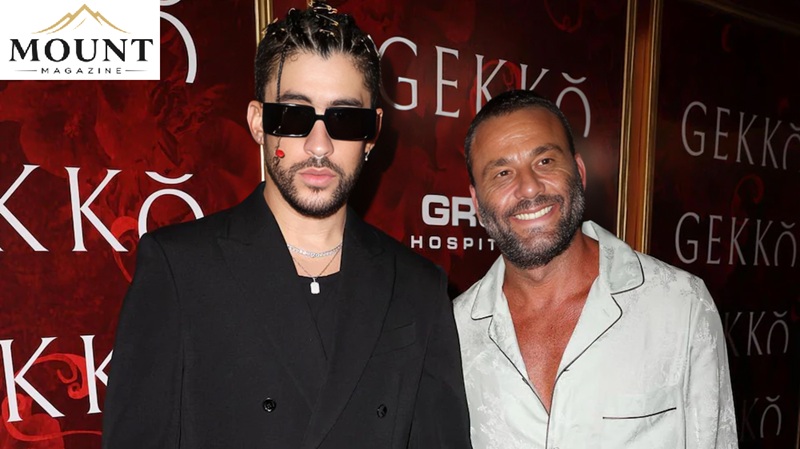
In August 2022, Bad Bunny co-opened Gekkō — a Japanese-inspired steakhouse and lounge in Miami’s Brickell neighbourhood — with hospitality entrepreneur David Grutman of Groot Hospitality. The name means “moonlight” in Japanese, and the restaurant was designed by Rockwell Group, the New York City-based architecture and design firm, with a jewel-toned, luxurious interior featuring bamboo rafters, a central sushi bar, a large gold-plated dragon wall sculpture, and a signature rope installation of gold and red dip-dyed rope. The space seats up to 185 diners across an indoor-outdoor flow.
The menu is meat-centric and Japanese-influenced: premium Wagyu cuts including an olive-fed filet mignon from Kagawa, Japan, a snow beef strip from Hokkaido, and a full Tomahawk — alongside innovative sushi, lobster dumplings, exotic oysters, and a bespoke cocktail programme. The lounge component features resident DJs and late-night service, making Gekkō a dining and nightlife destination rather than a pure restaurant play.
Bad Bunny described his vision for the restaurant at opening: “Sitting down with friends to enjoy a good meal is one of the moments I value the most. I am thrilled that now I will have a hand in creating this experience for others.” The project reflected a broader pattern: an artist whose ambitions extend deliberately beyond music into the hospitality, fashion, and entertainment spaces that have historically been reserved for longer-established celebrity brands.
Advocacy, LGBTQ+ Allyship, and Political Action
The social and political dimensions of Bad Bunny’s public identity are inseparable from his artistic one. In July 2019, following the leak of messages from Puerto Rico’s Governor Ricardo Rosselló revealing homophobic and sexist comments, Bad Bunny interrupted his European tour, flew from Ibiza to San Juan, and joined more than 500,000 protesters in the streets. The Governor resigned. His LGBTQ+ advocacy has been consistent and specific — appearing in drag in the “Yo Perreo Sola” video, kissing a male dancer at the 2022 MTV VMAs, and receiving the 2023 GLAAD Vanguard Award from Ricky Martin. In March 2023, he deliberately excluded US tour dates from his Debí Tirar Más Fotos World Tour over concerns about potential ICE raids at his concerts — making the Super Bowl his only American performance of the album cycle.
Acting, WWE, and Life Beyond Music
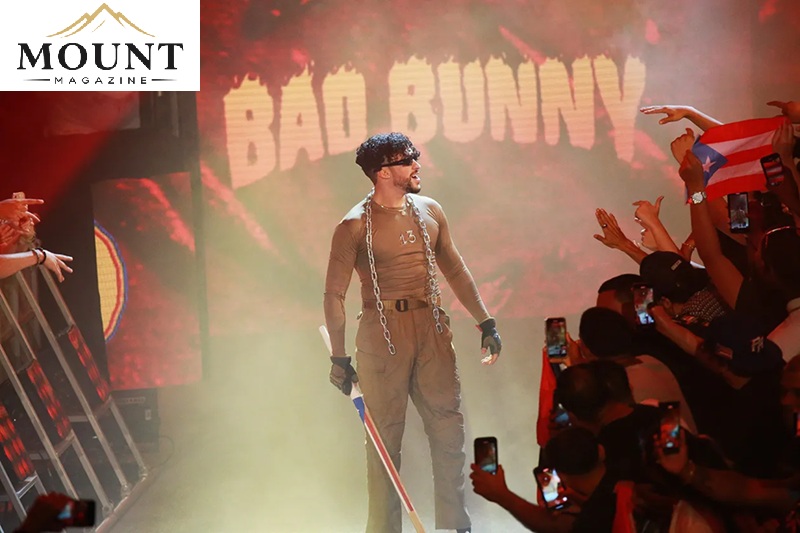
Bad Bunny made his film debut in Bullet Train (2022) alongside Brad Pitt, playing Wolf — a cartel assassin — performing many of his own stunts. He appeared in the biographical wrestling film Cassandro (2023) and Happy Gilmore 2 (2025) with Adam Sandler. His WWE involvement from 2021 to 2023 produced a WrestleMania 37 tag team victory, the 24/7 Championship, and a singles match at Backlash in Puerto Rico in May 2023 — the latter before a home crowd whose response was unlike anything WWE had produced in years. The professional wrestling involvement is, by his own account, the fulfilment of a lifelong fan obsession.
Puerto Rico, Philanthropy, and the Good Bunny Foundation
Since 2018, Bad Bunny has hosted Bonita Tradición — an annual holiday event in Puerto Rico at which he distributes toys, musical instruments, sports equipment, and art supplies to children in underserved communities. In January 2025 he personally delivered instruments and art kits to the neighbourhood in Vega Baja where he grew up. In 2019 he partnered with Marc Anthony to donate $1.6 million to rebuild twenty-five Puerto Rican baseball fields destroyed by Hurricanes Irma and María, working through UNICEF and the nonprofit LISC to prioritise rural municipalities including Vega Baja, Loíza, Yabucoa, and Yauco.
A Global Figure Who Never Stopped Being From Vega Baja
The career of Bad Bunny is the story of what happens when a specific cultural identity is pursued with complete artistic integrity at a moment when the market is finally prepared to receive it. He did not change his language, moderate his politics, soften his gender presentation, or distance himself from the reggaeton roots that the mainstream music industry had previously treated as a niche. He made music in Spanish, about Puerto Rico, for people who love both — and the world, eventually, came to him. The Grammy that Debí Tirar Más Fotos won on February 1, 2026 was not awarded to a Spanish-language album; it was awarded to a great album that happened to be in Spanish. The Super Bowl halftime show seven days later was not a Spanish-language performance; it was a Puerto Rican performance that was also, unmistakably, an American one. Between those two moments — and behind Gekkō’s gold dragon wall in Brickell, and in the Vega Baja barrio he returns to every December with toys — the distinction is the entire argument, and he has been making it his whole career.

