


Eduardo Hagn is a Chilean sports journalist and digital football analyst who has become one of the most recognized independent voices in Arsenal FC coverage worldwide. Born and raised in Santiago, Chile, he transformed a childhood obsession with football and the Premier League into a credible media career built entirely on the foundation of digital platforms, tactical intelligence, and consistent engagement with a global fanbase. At approximately 24 years old, Hagn represents a new archetype in sports journalism — one defined not by a newsroom desk or a press credential, but by the trust he has earned one post at a time.
| Quick Facts | Details |
|---|---|
| Full Name | Eduardo Hagn |
| Nationality | Chilean |
| Age | Approximately 24 years old |
| Based In | Santiago, Chile / Miami, USA |
| Profession | Sports Journalist, Football Analyst, Digital Content Creator |
| Specialization | Arsenal FC, Premier League |
| Education | Journalism (University of Chile), Business Administration (Florida National University) |
| Media Affiliation | ESPN Chile (contributor) |
| Primary Platforms | X (formerly Twitter), Instagram, YouTube, TikTok |
| Notable Achievement | Named among Top 500 most influential people on X (2023) |
What makes Eduardo Hagn particularly compelling is the intersection he occupies: he is simultaneously a passionate Arsenal supporter and a disciplined analyst. Rather than hide that fan identity, he has leveraged it as a point of connection, building a following that values his transparency as much as his tactical knowledge. He answers questions about formation tweaks, squad selection dilemmas, and transfer strategy with the kind of clarity that separates informed commentary from noise. For followers in Chile, Latin America, and beyond, he has become the go-to source for understanding not just what happened in an Arsenal match, but why.
From Santiago to the Premier League: The Origins of a Football Mind
Growing up in Chile means growing up inside a football culture where the game is conversation, identity, and community all at once. Eduardo absorbed this environment early, developing a fascination with football tactics long before he considered journalism as a career path. He wasn’t just watching matches — he was studying them, paying attention to pressing triggers, positional rotations, and the small decisions that determine large outcomes.
His attention eventually locked onto Arsenal FC, a club whose commitment to structured, attacking football matched his analytical sensibilities. Through the early years of his interest, he watched the club navigate identity crises, managerial transitions, and tactical reinventions. Rather than disengaging during difficult seasons, Hagn deepened his understanding — building the knowledge base that would later distinguish his commentary from surface-level fan reaction.
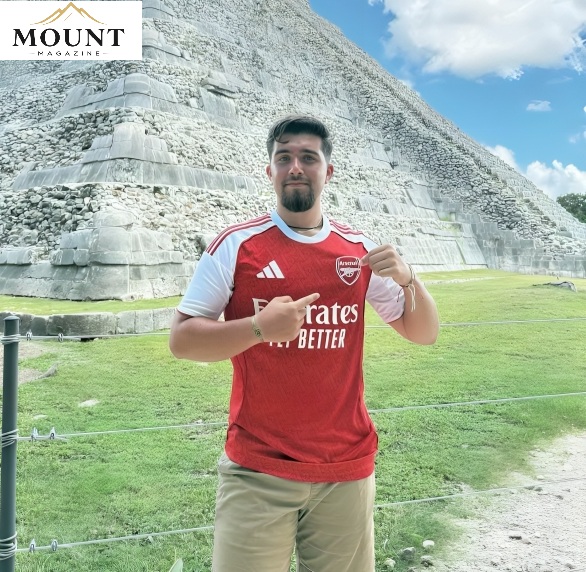
His academic path reflects this analytical disposition. At the University of Chile, he studied Journalism, developing formal skills in sourcing, writing, and media ethics. He later pursued Business Administration at Florida National University in Miami, a choice that might seem unconventional for a football commentator but proves strategically astute. Modern football is a billion-dollar industry. Understanding player valuations, club finances, and transfer market mechanics requires more than football knowledge — it requires financial literacy. This dual education gave Hagn a perspective competitors frequently lack.
Building a Voice: The Social Media Ascent
Eduardo Hagn’s career did not begin with a job offer from a broadcaster. It began with posts on X (formerly Twitter) — short, sharp observations about Arsenal’s tactical setups that quickly stood out from the mass of fan opinion that floods the platform after every match.
What differentiated his early content was structure. While most reactions focused on results — celebrating wins, processing defeats — Hagn consistently zoomed out to ask bigger questions. Why did the midfield press so high in the second half? What did the fullback positioning in transition tell us about the manager’s defensive philosophy? How did the personnel choice reflect the club’s broader recruitment strategy? These were not questions casual fans typically asked. They were the questions that serious analysts ask — and Hagn was asking them publicly, clearly, and consistently.
The response was gradual at first, then accelerating. Arsenal supporters, starved for thoughtful analysis delivered without the condescension of traditional broadcast punditry, found in Hagn a commentator who respected their intelligence. His following grew not through viral controversy but through reliable quality — a rarer and more durable kind of growth.
By 2023, this consistency earned him recognition as one of the Top 500 most influential people on X, a milestone that signaled his transition from niche commentator to a legitimate voice in football media. That recognition opened doors: podcast appearances, collaborations with sports websites, and contributions to ESPN Chile’s football coverage, where his analysis was woven into discussions aimed at Latin American audiences following European football.
The Anatomy of His Analytical Approach
Understanding why Eduardo Hagn resonates requires understanding what he actually does with a football match. His work goes well beyond match reports.
When Arsenal plays, Hagn dissects the tactical framework — the pressing triggers, the shape in possession, the defensive compactness out of it. He identifies what worked and, crucially, explains why it worked in terms of spatial relationships and player movement. He connects the performance to the broader context of where the club is in the season, what the manager has been building toward, and how the opposition set up to disrupt it.
During transfer windows, he brings the same contextual discipline. Transfer rumours are notoriously chaotic — a swirl of speculation, agent briefings, and wishful thinking. Hagn filters this noise through a tactical lens: not just who Arsenal might sign, but why that profile makes sense given the system, what gap it fills in the squad, and how it might change the team’s attacking or defensive shape. This kind of structured framing transforms transfer news from gossip into strategy discussion.
He also practices a form of journalistic honesty that is less common than it should be among fan-aligned commentators. When Arsenal underperform, he says so. When tactical decisions look questionable in hindsight, he revisits them without deflection. This willingness to criticize the club he supports openly preserves the trust his audience places in him — and distinguishes his work from the cheerleading that characterizes much fan media.
The ESPN Chile Connection and Broader Media Reach
While Hagn’s brand is fundamentally digital and independent, his relationship with ESPN Chile has added an institutional layer to his media presence. ESPN Chile operates as part of one of the world’s most recognized sports broadcasting networks, and its football coverage reaches audiences across South America who follow European football with intensity equal to any English fanbase.
Hagn’s contributions to ESPN Chile serve a specific function: bridging the gap between Latin American fans and the nuances of Premier League football. He translates not just language but context — explaining the significance of certain fixtures, the history behind rivalries, and the tactical culture that shapes how English clubs approach the game. For Chilean football fans who grew up watching their domestic league but developed a passion for Arsenal or the Premier League more broadly, Hagn provides the cultural translation that makes European football feel accessible rather than foreign.
His ESPN Chile work also demonstrates that institutional media and independent digital journalism are not mutually exclusive. Hagn maintains his independent voice and audience on social platforms while contributing to a major broadcast network — a hybrid model increasingly common among the most effective digital sports journalists.
What His Rise Signals About Modern Football Journalism
| Traditional Sports Journalism | Eduardo Hagn’s Model |
|---|---|
| Newspaper/broadcast institution | Independent digital platforms |
| Press credentials and access | Audience trust and analytical credibility |
| Top-down distribution | Direct fan engagement and dialogue |
| Broad coverage across topics | Deep specialization in one club/league |
| Distance from fan identity | Transparency about supporter identity |
Eduardo Hagn’s trajectory is not just a personal success story — it is a case study in how football journalism is restructuring itself. The traditional model, where credibility flowed from institutional affiliation, is being challenged by a new model where credibility flows from consistency, accuracy, and the genuine depth of analysis delivered directly to audiences.
Independent analysts like Hagn have demonstrated that you do not need a press box seat to understand a game more clearly than someone sitting in one. What you need is knowledge, discipline, and the ability to communicate complex ideas in terms that make audiences feel enlightened rather than lectured.
His success has also underlined something important about the specific demands of digital journalism: speed matters, but not at the expense of accuracy. Hagn’s reputation has been built partly on the fact that he clarifies when information is speculative, avoids sensationalism, and corrects course when initial interpretations prove wrong. In an information environment where rumour and fact travel at the same velocity, that commitment to epistemic honesty is both rare and powerful.
The Road Ahead
At approximately 24 years old, Eduardo Hagn is in the earliest chapters of what projects to be a long career in football media. The platforms he has mastered — X, Instagram, YouTube, TikTok — continue to evolve, and his capacity to adapt to new formats will likely determine how far his reach extends. He has expressed ambitions that go beyond digital commentary: broader collaborations with international outlets, involvement in major tournament coverage, and potentially educational content aimed at aspiring analysts who see in his career a model worth following.
What seems clear is that his foundation is unusually strong for someone at this stage. A dual academic background in journalism and business, a deep specialist knowledge of one of the world’s most followed football clubs, an established audience built through genuine quality, and a reputation for integrity — these are assets that compound over time.
For Arsenal fans, he will remain the voice that makes sense of each season as it unfolds. For the broader football media landscape, he stands as evidence that the next generation of respected analysts will look very different from the ones who came before — and that the best among them will have earned their audience the hard way.
Conclusion
Eduardo Hagn is more than a social media personality or a passionate Arsenal supporter who got lucky with an audience. He is a working journalist with academic credentials, a refined analytical method, institutional media connections, and a hard-earned global following. His story — from Santiago, Chile, to recognized voice in Premier League analysis — reflects both the democratization of sports media and the enduring truth that quality, over time, finds its audience. In a digital landscape saturated with football opinion, he has managed the more difficult achievement: delivering football knowledge that actually makes people think differently about the game.

