


Cassidy Hutchinson net worth is estimated at between $1.5 million and $3 million in 2026 — a figure that represents the financial outcome of one of the most consequential individual decisions made by any aide in modern White House history. She was 25 years old when she sat before the House Select Committee on January 6 and described, in precise and damning detail, what she had seen and heard in the final hours before the Capitol was stormed. She was 26 when her testimony became the most watched and most discussed moment of the Committee’s public hearings. She was 26 when she published Enough, the memoir that put everything she had witnessed and survived into permanent record.
| Quick Facts | Details |
|---|---|
| Full Name | Cassidy Jacqueline Hutchinson |
| Date of Birth | December 12, 1996 |
| Age (2026) | 29 years old |
| Birthplace | Pennington, New Jersey, USA |
| Father | Richard Jeffery Hutchinson (owns Arbor Barber Tree Experts, New Jersey) |
| Mother | Angela Hutchinson |
| Sibling | Jack Hutchinson (younger brother) |
| High School | Hopewell Valley Central High School, NJ (graduated 2015) |
| University | Christopher Newport University, Newport News, Virginia |
| Degree | Bachelor of Arts — Political Science and American Studies (graduated 2019) |
| First Internship | Sen. Ted Cruz, summer 2016 |
| Second Internship | House Majority Whip Steve Scalise, summer 2017 |
| Third Internship | White House Office of Legislative Affairs, summer 2018 |
| White House Title | Special Assistant to the President and Coordinator for Legislative Affairs |
| Direct Superior | Mark Meadows, Chief of Staff |
| White House Salary | ~$90,000 per year (per GSA records) |
| Landmark Testimony | June 28, 2022 — House Select Committee on January 6 |
| Memoir | Enough — Simon & Schuster, September 2023 |
| Net Worth (est. 2026) | $1.5 million – $3 million |
| Marital Status | Unmarried; personal life kept private |
| Current Location | Washington, D.C. area |
The numbers that constitute Cassidy Hutchinson’s net worth are, on their own, unremarkable relative to political Washington’s usual financial architecture. What makes them significant is what they cost to earn — the legal exposure, the social rupture, the professional uncertainty, and the personal isolation that came from refusing to do what almost everyone around her had done: stay quiet, stay loyal, and stay safe. Her wealth is small by the standards of Washington insiders who leave government for lobbying or corporate boards. It is considerable for someone who was a 25-year-old first-generation college graduate from a working-class family in New Jersey who chose principle over security at exactly the moment when the personal cost of that choice was at its highest.
Pennington, New Jersey: Where the Story Starts
Cassidy Hutchinson was born on December 12, 1996, in Pennington, New Jersey — a small borough in Mercer County, the kind of place whose middle-class character is shaped by proximity to both Trenton and Princeton without fully belonging to either. Her father, Richard Jeffery Hutchinson, runs Arbor Barber Tree Experts, a local tree service business. Her mother, Angela Hutchinson, managed the household alongside a younger brother, Jack. By any measure, it was a working-class upbringing — not poor, but not cushioned by the kind of professional networks that typically funnel young people into the corridors of American political power.
She has described herself publicly as a first-generation college student, and the significance of that detail should not be underestimated. First-generation college students navigate higher education without the inherited map that students with college-educated parents carry instinctively — without knowing, from dinner conversation and family expectation, what opportunities exist, how to pursue them, or what it looks like when someone from your background actually reaches them. Hutchinson had to figure that out herself, and the evidence of how thoroughly she did so is the career that followed.
She attended Hopewell Valley Central High School, graduating in 2015, and arrived at Christopher Newport University in Newport News, Virginia — a public institution in a city that is itself a working-class town built around the shipbuilding industry. She chose to study political science and American studies, a combination that reflected a genuine intellectual interest in how power operates and what the nation means, rather than a calculation about employability. The interest in government was not strategic. It was real.
The Internship Ladder: Building the Career Nobody Expected
The biography of how Cassidy Hutchinson entered the White House at 22 years old is a study in what relentless effort combined with genuine ability produces when applied consistently in the right direction.
While still pursuing her undergraduate degree, she interned for Senator Ted Cruz in the summer of 2016 — a placement that gave her her first direct experience of how the Senate operates and how political offices function at the staff level. She returned to Washington the following summer as an intern for House Majority Whip Steve Scalise, moving from the Senate side to the House and expanding her understanding of the legislative branch’s internal dynamics. Both placements were with conservative Republican figures, which reflects the political alignment she held at the time and would later complicate so dramatically.
In the summer of 2018 — the summer before her senior year — she interned in the White House Office of Legislative Affairs under the Trump administration. The step from congressional intern to White House intern is not a small one. It requires a combination of demonstrated capability, political alignment, and the kind of interpersonal impression that causes busy offices to extend opportunities they are not obligated to extend. She made that impression.
After graduating from Christopher Newport University in 2019 with her Bachelor of Arts in Political Science and American Studies, she converted her internship into a full-time position in the White House Office of Legislative Affairs. She was 22 years old. Her first recorded government salary was approximately $72,700 in 2019 — modest by any private-sector standard for a recent graduate, standard for a junior White House staff role, and a foundational income for someone building from scratch in one of the most expensive cities in the country.
The West Wing: Meadows’s Principal Assistant
The trajectory of Hutchinson’s White House career accelerated significantly in March 2020, when Mark Meadows replaced Mick Mulvaney as Donald Trump’s fourth Chief of Staff. Meadows selected Hutchinson as one of his aides, and she was rapidly elevated to his principal assistant — his closest day-to-day staff presence, the person who took notes at his meetings, monitored his phone, relayed his orders, and traveled with him. Her formal title was Special Assistant to the President and Coordinator for Legislative Affairs. Her office was next to Meadows’s, down the hall from the Oval Office.
The position placed her at the operational centre of one of the most chaotic and consequential periods in modern American political history. She was present for, or had documented knowledge of, decisions and conversations that touched directly on the 2020 election, the attempts to overturn it, and the planning and execution of the events of January 6, 2021. She was not a senior figure. She was not a decision-maker. She was the person who was always in the room, always watching, always taking notes — and who would eventually have to decide what to do with everything she had seen.
Her White House salary reached approximately $90,000 per year during this period, according to General Services Administration documents. Total cumulative government earnings across her White House tenure amounted to approximately $250,000 — a number that reflects the reality of public service compensation rather than the scale of her actual access and responsibility.
The January 6 Testimony: The Decision That Defined Everything
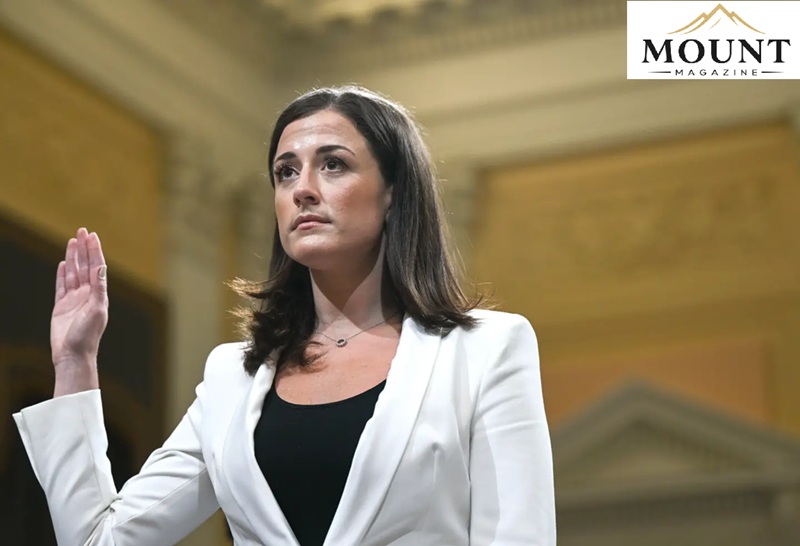
On June 28, 2022, Cassidy Hutchinson testified publicly before the House Select Committee investigating the January 6, 2021 attack on the United States Capitol. She was 25 years old.
The testimony ran for approximately two hours. In it, she described what she had witnessed and heard in the White House in the days and hours surrounding January 6 — including her account of being told by Tony Ornato, the White House Deputy Chief of Staff, that Trump had attempted to grab the steering wheel of the presidential vehicle when the Secret Service declined to take him to the Capitol after his speech, and had lunged toward an agent when physically stopped. She testified that she had heard Trump say, in reference to armed supporters at the rally, that he did not care that they had weapons because “they’re not here to hurt me.” She described Mark Meadows’s passivity in the face of mounting warnings. She described the atmosphere in the White House as the attack was unfolding.
The testimony was described by multiple major news outlets as the most significant of the Committee’s public hearings. It was televised live and watched by millions. Trump’s response on Truth Social — “I hardly know who this person, Cassidy Hutchinson, is” — became one of the most quoted political denials of the year, its unconvincing phrasing undermining itself.
What made the testimony significant beyond its content was the context in which it was delivered. Hutchinson had received messages from Trump allies before her earlier depositions suggesting she demonstrate loyalty. Her original attorney, Stefan Passantino, had deep connections to Trump associates and, she later alleged, had directed her not to recall information that she actually remembered. She dismissed Passantino and retained Jody Hunt, a former Justice Department official with no connection to the Trump orbit. The act of changing lawyers — mundane in legal terms, seismic in political ones — was itself a declaration of independence. The public testimony was its fulfilment.
Enough: The Memoir and Its Financial Impact
In September 2023, Simon & Schuster published Hutchinson’s memoir, Enough — a first-person account of her political journey, her time in the Trump White House, and the experiences leading to and following her testimony. The book detailed additional allegations that had not been part of her Committee testimony, including that Rudy Giuliani had groped her backstage during Trump’s speech on January 6, and that Matt Gaetz had made repeated inappropriate advances toward her in 2020.
Enough became a bestseller. Publishing industry analysis of political memoirs at her profile level suggests a Simon & Schuster advance in the range of $250,000 to $500,000 — a figure that would represent the single largest payment in Hutchinson’s financial history and the primary engine of her post-government net worth. Royalties from ongoing book sales and foreign rights would add to that total over time.
The memoir’s title is significant. It is not a word that requires explanation when you understand the story it sits atop. It is the word someone says when they have decided that the cost of silence has finally exceeded the cost of speaking.
| Cassidy Hutchinson: Income Sources | Estimated Amount |
|---|---|
| White House salary (2019–2021) | ~$250,000 cumulative |
| Enough advance (Simon & Schuster, 2023) | $250,000–$500,000 (est.) |
| Book royalties (ongoing) | $100,000–$200,000+ (est.) |
| Speaking engagements (per appearance) | $15,000–$50,000 (est.) |
| Consulting / advisory work | Undisclosed |
| Estimated Total Net Worth (2026) | $1.5 million – $3 million |
Speaking Career and Public Life After the Memoir
Following the publication of Enough, Hutchinson became a sought-after speaker on the civic engagement circuit — university campuses, political forums, and events organised around democracy and accountability. Political speakers with her profile and the specificity of her direct experience typically command between $15,000 and $50,000 per engagement, though her exact fee arrangements have not been publicly disclosed.
She has appeared at events hosted by progressive-leaning and nonpartisan civic organisations — a public positioning that represents a significant shift from the conservative Republican alignment of her White House internship years. The shift is not unexplained. It is, if anything, one of the more coherent political evolutions in recent American public life: a young person who entered politics through conventional conservative channels, saw up close what that politics produced in its most unguarded moments, and decided that her allegiance to democratic principle outweighed her allegiance to party.
She has also appeared on major television programmes and continued to contribute to public discussion of January 6, accountability, and the functioning of American democracy — maintaining a media presence that keeps her professionally relevant and her speaking value intact.
Family, Personal Life, and the Estrangement That Came With It
One of the most quietly devastating details in Hutchinson’s public story is the account of her father’s response to her legal situation. As she sought legal representation to testify before the January 6 Committee, her father — Richard Hutchinson — reportedly declined to assist her in finding a lawyer. The refusal, in a moment when she needed support most acutely, deepened the estrangement between them. Their relationship, by all accounts, remains distant.
Her mother, Angela Hutchinson, and brother Jack have been more consistent presences. But the broader social cost of her testimony — the loss of friends, professional contacts, and the entire network she had built through years of working in conservative Republican politics — is something she has acknowledged directly in interviews and in the memoir itself.
She has kept her romantic life entirely private. No partner or relationship has been confirmed publicly. She lives in the Washington D.C. area, consistent with her ongoing professional engagement with the political and civic world the capital hosts.
The Real Value of Cassidy Hutchinson Net Worth
The most honest accounting of Cassidy Hutchinson net worth requires separating two different things that the number can mean.
As a measurement of accumulated financial assets, the estimated $1.5 million to $3 million is a modest achievement for a 29-year-old who has been among the most talked-about political figures in the country for four years. It is below the figures routinely attributed to her by less careful sources — some of which have published wildly inflated estimates that bear no relationship to the verifiable facts of her income history. She was a government aide earning $90,000 a year. She wrote a memoir on a major publishing deal. She speaks at events for fees that are meaningful but not enormous. The math produces a real number in a real range, not a speculative fortune.
As a measurement of what was paid and what was received, the number tells a different story. She forfeited the post-presidency operation role in Florida that Trump had initially promised. She forfeited the conservative political network she had spent years building. She replaced her lawyer under pressure and testified against the most powerful political operation in Republican politics — at 25, with limited financial resources, without family support, and with no guarantee that what she was doing would change anything.
The net worth is what remained after all of that. Whether it constitutes fair compensation for what it cost is a question that has nothing to do with dollars.
Conclusion
Cassidy Hutchinson net worth of approximately $1.5 million to $3 million in 2026 is the financial expression of a career built almost entirely on two things: exceptional work in a position most people never reach, and a single act of public honesty that cost her nearly everything she had built. From a working-class household in Pennington, New Jersey, to a desk next to the White House Chief of Staff’s office at 24, to the witness chair of the most consequential congressional hearing in a generation at 25, Cassidy Hutchinson navigated a trajectory that nobody had mapped for someone with her background. The money is real. The cost was realer.

