


| Quick Facts | Details |
|---|---|
| Full Name | Dianne Kay Holechek |
| Date of Birth | November 27, 1941 |
| Birthplace | Los Angeles, California, USA |
| Date of Death | December 21, 2025 |
| Place of Death | Texas, USA — peacefully at home |
| Age at Death | 84 years old |
| Cause of Death | Dementia — long battle |
| Education | North High School, Torrance, California |
| Ex-Husband | Chuck Norris (born March 10, 1940, Ryan, Oklahoma) |
| Met Chuck | Late 1950s — North High School, Torrance, CA; she was 15, he was 16 |
| Married | December 29, 1958 — Chuck wore Air Force uniform; Dianne wore traditional gown |
| Honeymoon | Big Bear, California — four days |
| Marriage Duration | 30 years |
| Separated | 1988 |
| Divorce Finalised | 1989 |
| Sons | Mike Norris (b. 1962 — actor/director); Eric Norris (b. 1965 — NASCAR driver/stunt coordinator) |
| Grandchildren | Seven |
| Chuck’s affair | 1962–63 — with Johanna while serving in U.S. Air Force; daughter Dina born; Dina contacted Chuck in 1991 |
| Restaurant | Woody’s Wharf — Newport Beach, California; Chuck gave her $600,000 to start it (1983); “No. 1 restaurant in town” |
| TV appearance | Hollywood ’84 (1984) — minor role |
| Post-divorce | Did not remarry; remained close friends with Chuck; lived privately in Texas |
| Chuck’s 2nd wife | Gena O’Kelley — married November 1998; twins Dakota and Danilee born 2001 |
| Chuck’s net worth | ~$70 million |
| Dianne’s net worth (est.) | Undisclosed; fair divorce settlement likely; modest lifestyle |
| Social media | None — completely private throughout life |
On December 21, 2025, Chuck Norris posted a black-and-white photograph to his Facebook page. It showed him alongside Dianne Holechek and their two sons, Mike and Eric, taken in 1975 — the year his career was beginning its ascent toward the global recognition that would follow. “I am deeply saddened to share that my ex-wife, Dianne, has passed away,” he wrote. “After being married for 30 years, we were able to find a way to remain close friends, and those years of friendship meant the world to me.”
Dianne Kay Holechek had died peacefully at her home in Texas, at the age of 84, after a long battle with dementia. Their son Mike — actor, director, and the eldest of their two children — told TMZ: “We are thankful she is no longer suffering. She was the best, the greatest mom. We were so lucky to have her.”
The tributes told a specific kind of story: not the story of a celebrity wife who had shared her husband’s spotlight, but of a woman who had been present before the spotlight existed — who had known Chuck Norris when he was a teenager in Torrance, California, with a disciplined personality and ambitions that had not yet found their form, and who had remained, across thirty years of marriage, two sons, one deeply painful act of infidelity, a divorce, and decades of subsequent friendship, a constant presence in the life of a man the world came to know as one of its most enduring action icons. Dianne Holechek chose, throughout all of it, to live as privately as possible. The world knew her name primarily through his. Her story, examined on its own terms, is considerably more than that context suggests.
Los Angeles, 1941: The Childhood That Shaped Everything
Dianne Kay Holechek was born on November 27, 1941, in Los Angeles, California — eleven days before the Japanese attack on Pearl Harbor would bring the United States into the Second World War and fundamentally alter the country whose values and culture would shape her upbringing. She grew up in the Los Angeles of the 1940s and early 1950s — a city that was, in the neighbourhoods away from Hollywood, community-centred, modest, and shaped by the specific American values of the postwar era: family, hard work, faith, and the quiet stability that a generation that had lived through depression and war had learned to prize above almost everything else.
Her specific family background — her parents’ names, her siblings if she had any, the precise neighbourhood in which she grew up — is not documented in the public record with detail. She did not, in her adult life, give interviews; she did not write memoirs; she did not participate in the documentary reconstruction of her own biography that celebrity adjacency sometimes produces. What is documented is the character that her childhood formed: a calm, grounded, unpretentious young woman who valued friendship and stability, who had no particular orientation toward the Hollywood world that existed geographically nearby, and who would later demonstrate, across decades, that those values were genuinely held rather than performed.
She attended North High School in Torrance, California — the school that Chuck Norris’s family had moved to when he was twelve years old, following the family’s relocation from Ryan, Oklahoma to the Los Angeles area. The school, whose student body in the mid-1950s was shaped by the suburban working and middle-class communities of the South Bay area, is where the most consequential meeting of Dianne Holechek’s life took place.
North High School: Where It Started
Chuck Norris has described the beginning of their relationship with the specificity of someone for whom the memory remained vivid decades later: “We went together for almost two years, and she was 15 when I started dating her. I was 16 at the time, and then I married her when she was 17.”
The courtship was a teenage romance of the mid-1950s variety — walks, conversations, shared laughter, the slow development of a bond between two young people who had recognised something in each other before either had the vocabulary to describe what it was. Chuck was already developing the disciplined, sports-oriented personality that his martial arts career would later formalise; he played football and gymnastics at North High. Dianne was, by the accounts preserved in biographical sources, the steadier presence — the grounded, kind, patient young woman whose character complemented his ambition in the specific way that certain teenage relationships demonstrate their eventual longevity even before it is proven.
Before they could marry, Chuck enlisted in the United States Air Force. He was stationed in South Korea, and the relationship that had formed in the corridors and schoolyards of North High School was tested by the specific distance and uncertainty of military service overseas. They stayed in touch through handwritten letters — the primary communication technology available to a young couple separated by the Pacific in the late 1950s. The emotional connection that those letters sustained was, by every account, the foundation of the commitment that followed.
From South Korea, Chuck wrote Dianne a letter proposing marriage. She said yes. The proposal by post — romantic in its circumstances, practical in its necessity — captures something about both of them: his directness, her willingness to commit to a future that was still largely unformed.
December 29, 1958: The Wedding
Dianne Holechek and Chuck Norris married on December 29, 1958, in Torrance, California. She was seventeen years old. He was eighteen. Chuck wore his United States Air Force uniform — a detail that every account of the wedding preserves because it speaks so precisely to the circumstances of the marriage: a young serviceman, not yet discharged, not yet a martial artist or an actor, marrying the girl he had proposed to by letter from South Korea.

The wedding was attended by family and close friends — not a Hollywood event, not a public occasion, but a private ceremony whose simplicity reflected the modest means and straightforward values of both families. The honeymoon was four days in Big Bear, California — the San Bernardino Mountains resort town, accessible from Torrance by a few hours’ drive, whose lakes and forests offered the kind of peaceful, outdoor setting that neither of their budgets could have extended far beyond.
They returned from Big Bear to begin a married life built on the specific combination of circumstances that young military marriages of that era typically involved: limited money, significant uncertainty about the future, and the particular strength of a bond formed between two people who had chosen each other before the world had given either of them much to offer beyond themselves.
Thirty Years: The Marriage That Built a Family
The thirty years of marriage between Dianne Holechek and Chuck Norris covered one of the more extraordinary career arcs in American entertainment history — from discharged Air Force serviceman to martial arts champion to Hollywood action star — and Dianne was present for all of it, managing the domestic foundation that made the public trajectory possible.
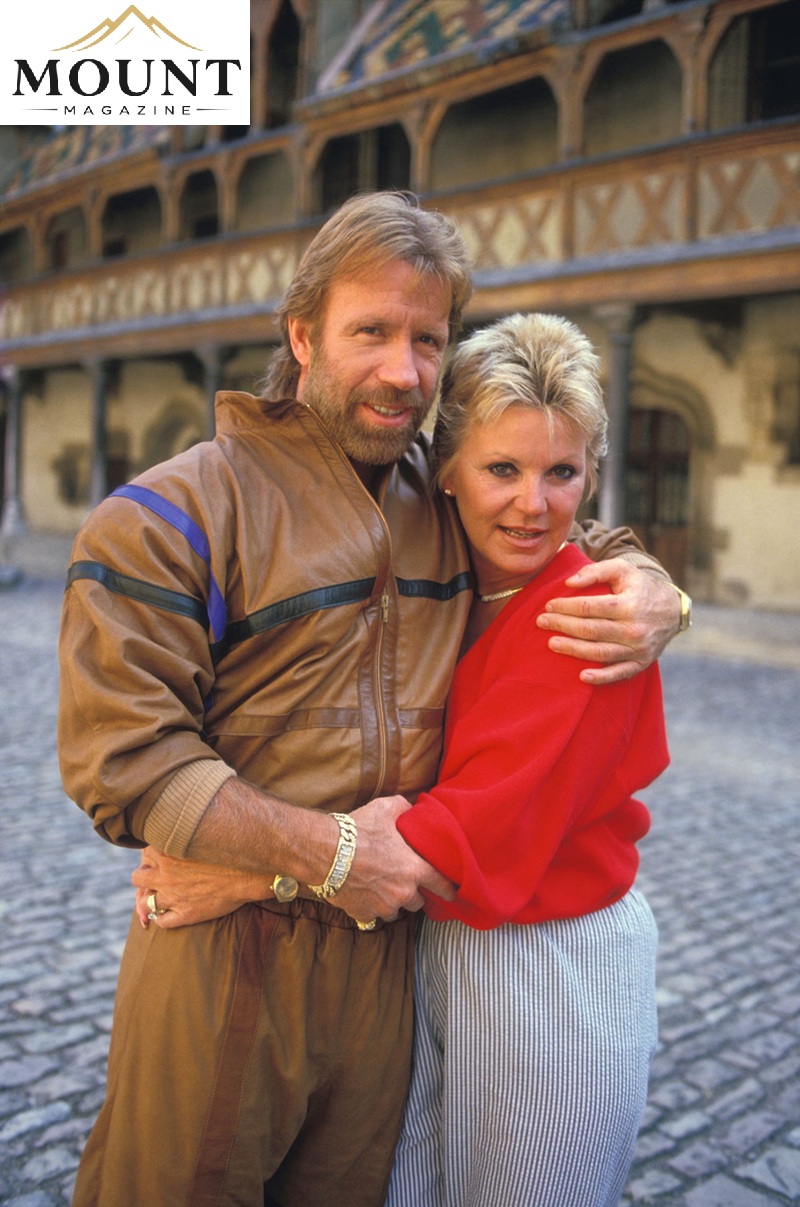
After Chuck’s discharge from the Air Force, he began teaching karate — opening schools and competing professionally, winning multiple championships across different martial arts disciplines through the 1960s. The karate school business was not immediately lucrative; the early years were financially modest, and Dianne’s management of the household during this period was the practical infrastructure on which his professional development depended. He recognised this explicitly in interviews: “She has always been very supportive of my goals,” he told The New York Times in September 1985, in a characteristically understated acknowledgement of what thirty years had actually contained.
In 1962, their first son Mike Norris was born. In 1965, their second son Eric Norris arrived. Mike would follow his father into the entertainment industry, building a career as an actor and director that included appearances in Rush Hour 3, The Crossroads of Hunter Wilde, and Where the Heart Is, as well as episodes of Walker, Texas Ranger alongside his father. Eric would take a different path — competitive NASCAR racing before transitioning into the film industry as a stunt coordinator and driver, earning professional respect in both disciplines on his own terms. Through her sons, Dianne became the grandmother of seven grandchildren — a role that, by every account, she cherished as deeply as any she had occupied.
The marriage produced — alongside its two sons and its professional achievements — one significant and painful rupture that Chuck Norris disclosed publicly only in his 2004 memoir Against All Odds: My Story. In 1962 or 1963, while serving in the United States Air Force, he had an affair with a woman named Johanna. He did not tell Johanna he was married. The relationship produced a daughter, Dina, whose existence Norris claimed not to have known about until 1991, when Dina contacted him. “To my shame, I never told Johanna that I was married,” he wrote in the memoir. The affair — and the daughter it produced — constituted the most significant breach in a marriage that otherwise endured for nearly three decades after it occurred. Dianne stayed. The marriage continued through Chuck’s rise to prominence in films like Way of the Dragon (1972, opposite Bruce Lee), Missing in Action (1984), Delta Force (1986), and the long-running television series Walker, Texas Ranger, which premiered in 1993 but whose development began in the late years of their marriage.
In 1985, Chuck credited the marriage’s durability to Dianne’s willingness to travel with him to filming locations. “She travels with me,” he told The New York Times. “If you go separate ways, then you know something’s going to happen. But she travels with me to my locations, and she’s on location most of the time, so we don’t separate for any extended period of time.” The statement is, in retrospect, both a genuine tribute and an inadvertent acknowledgement of the fragility it was designed to describe as strength.
Woody’s Wharf: The Woman Behind the Restaurant
One of the most specific and least-discussed facts in Dianne Holechek’s biographical record is also one of the most revealing: in 1983, Chuck gave her $600,000 to start a restaurant. The restaurant was Woody’s Wharf in Newport Beach, California — a waterfront establishment whose quality and management Dianne apparently developed with sufficient skill that, by 1985, Chuck was telling The New York Times: “It’s now the No. 1 restaurant in town.”
The restaurant represents the clearest documented evidence of Dianne Holechek’s independent professional capability — the fact that when she was given the resources and the opportunity to build something of her own, she built it well enough to achieve the kind of commercial success that is not guaranteed by capital investment alone. Running a restaurant, particularly a successful waterfront restaurant in a competitive California coastal market, requires operational intelligence, people management skills, and the specific combination of practical and aesthetic judgement that the restaurant business demands. She later sold the restaurant at a profit.
The Woody’s Wharf chapter of her biography sits somewhat incongruously alongside the dominant narrative of Dianne Holechek as the quiet homemaker in the background of her husband’s fame — because it documents a woman who was not simply maintaining a domestic space but building and operating a commercially successful business in her own right, under her own management, during the period of her marriage’s final decade.
The Divorce and Its Aftermath
Chuck Norris and Dianne Holechek separated in 1988. Their divorce was finalised the following year. They had been married for thirty years. The specific circumstances of the separation — beyond the general pressures of three decades of a demanding career, extended periods of filming and travel, and the lingering weight of the 1962 affair and its undisclosed daughter — were handled privately. No public statements were made that attributed blame or detailed grievances. The separation was conducted, as every aspect of Dianne’s public presence had been conducted, with a quiet dignity that declined to perform its pain for an audience.
She did not remarry. She withdrew from public life completely — no interviews, no social media, no appearances at industry events, no participation in the various documentary and retrospective projects that Chuck Norris’s ongoing career generated. She moved eventually to Texas, where she lived out the remaining years of her life in the private company of her sons, her grandchildren, and the friendships she had maintained away from the entertainment world she had never fully inhabited.
What makes the post-divorce period of Dianne’s story genuinely unusual in the context of Hollywood separations is not the privacy — which is understandable — but the friendship. Chuck Norris married model Gena O’Kelley in November 1998 and welcomed twins Dakota and Danilee in 2001. He and Dianne, despite the marriage’s end and his subsequent remarriage, remained, by his own explicit account, close friends. “After being married for 30 years, we were able to find a way to remain close friends, and those years of friendship meant the world to me,” he wrote on December 21, 2025. “Even as our lives took different directions, we continued to care deeply for one another.”
The maintenance of genuine friendship across the specific terrain of their history — the thirty years, the affair, the divorce — requires, on both sides, a quality of character that deserves acknowledgement. Whatever the marriage contained and whatever ended it, both people appear to have carried it forward into something that was better than its conclusion might have predicted.
Dementia and the Final Years in Texas
In the years before her death, Dianne Holechek developed dementia — the progressive neurological condition that erodes memory, personality, and the accumulated self of a life, and that imposes on both its subjects and those who care for them a particular and prolonged form of loss. The timeline of her diagnosis is not publicly documented with precision; what is confirmed is that she had been living with the condition for several years before her death.
She lived in Texas — a state she had adopted as home in the later chapter of her life, far from the Los Angeles of her childhood and the California of her marriage. Her sons were present. Her grandchildren were nearby. The private life she had always insisted upon became, in these final years, the specific mercy of a person who had never needed the world’s attention to feel that her life was full.
Mike Norris confirmed his mother’s death to TMZ on December 21, 2025. She had died peacefully at her Texas home. “We are thankful she is no longer suffering,” he said. “She was the best, the greatest mom. We were so lucky to have her.”
Chuck Norris’s Tribute: The Words He Chose
The Facebook statement that Chuck Norris posted on December 21, 2025 is worth reading in full as the document of a specific kind of relationship — one that was not simply a former marriage but something that had been transformed, across decades and difficulty, into genuine ongoing connection.
“Dianne was an incredible person. She was kind, intelligent, and lived life to the fullest. Her presence in my life will never be forgotten. She was also a loving and devoted mother to our sons, Mike and Eric, who were always her greatest pride. Even as our lives took different directions, we continued to care deeply for one another, and I will forever cherish the memories we built together.”
The words are careful — as words written for public consumption from a man of eighty-five about a woman he had divorced thirty-six years earlier must necessarily be. But the care is not evasion. It is the specific articulateness of someone who understood that what he was describing — a thirty-year marriage, a thirty-six-year post-divorce friendship, the mother of his sons — required language commensurate with its weight, and who found, in the moment of loss, that the weight was real.
Legacy: The Foundation Before the Fame
Dianne Holechek was not famous. She did not seek to be famous. She appeared in one minor television production — Hollywood ’84 (1984) — and otherwise constructed a public record so deliberately minimal that many of the biographical sources that attempt to document her life resort to inference and assumption where specific facts are absent. She ran a restaurant that Chuck Norris boasted about to The New York Times. She raised two sons who built their own respected careers. She maintained a friendship with the man she divorced. She died peacefully at home at eighty-four, surrounded by family, after a life she had lived on exactly the terms she chose.
The terms she chose were not passive. They were specific and active: the deliberate selection of privacy over publicity, of family over fame, of the private ordinary over the public extraordinary. In the specific context of Hollywood, where the gravitational pull toward visibility is constant and powerful, Dianne Holechek’s sustained resistance to that pull across eight decades is not a small achievement.
Chuck Norris became one of the most recognisable faces in world cinema. Dianne Holechek was there before the world knew his face. She knew the young man in the Air Force uniform at a small Torrance wedding, the karate teacher trying to build a business, the struggling actor whose first serious roles came when she was already a decade into motherhood. She saw the whole arc. She was the first person who believed in it.

